
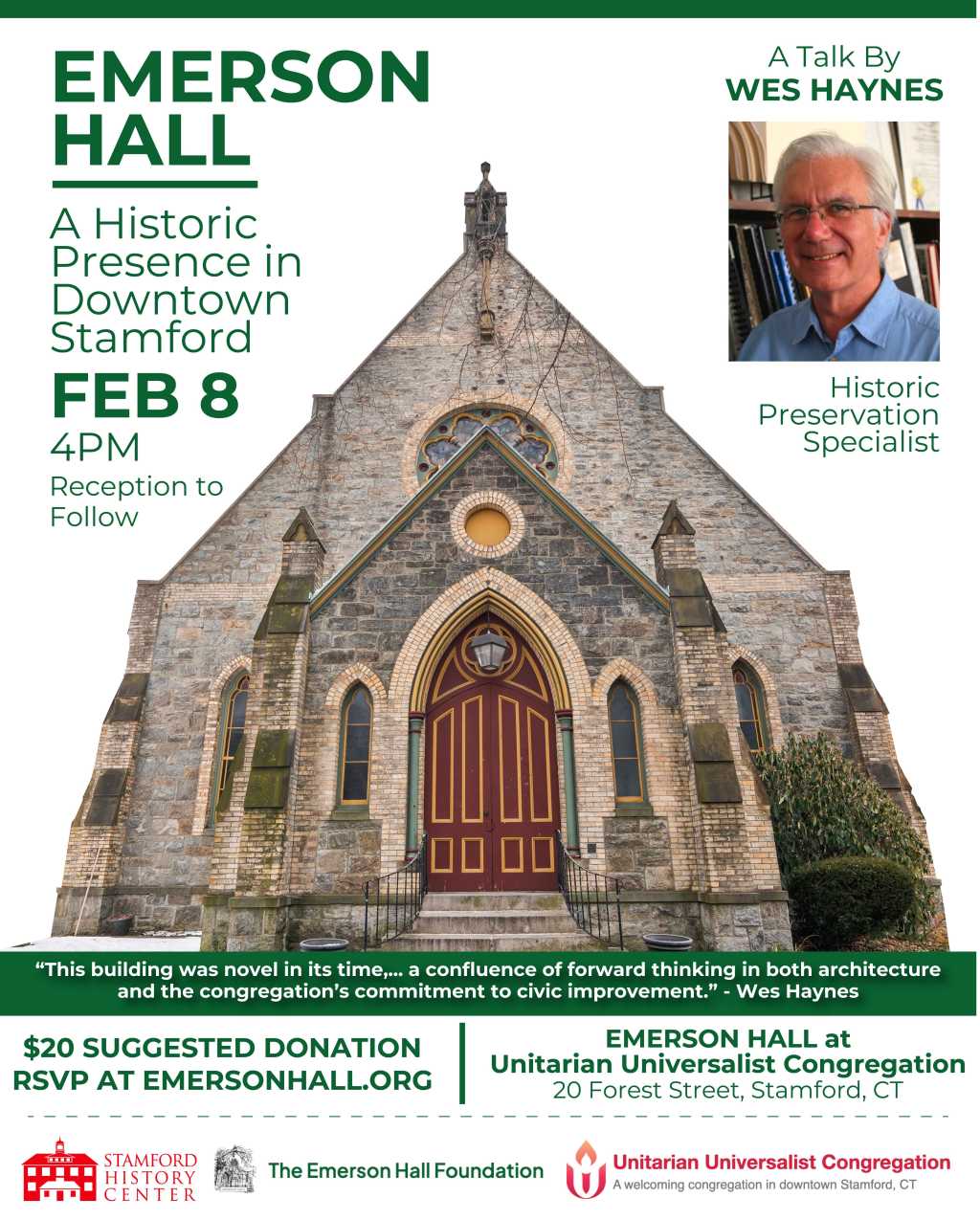
Emerson Hall Foundation, in partnership with the Unitarian Universalist Congregation in Stamford, and the Stamford History Center, was pleased to present a special lecture by noted architectural historian and Stamford native, Wes Haynes. Haynes offered a fascinating exploration of Emerson Hall, one of the city’s most significant and historic buildings. Built in 1870 by the Second Universalist Society of Stamford, Emerson Hall is a stunning example of the Reform Gothic architectural style. Erected on what was once the rural outskirts of Stamford, it stands today as a rare survivor of its kind in the downtown area, and is one of only two such structures in the city. Considered one of the finest examples of English Country Gothic architecture in the region, the church and its historic rectory—converted in the 1990s into transitional housing apartments—are both listed on the National Register of Historic Places and are part of the Downtown Historic District.
Haynes saw in Emerson Hall a correlation between the progressive nature of Universalism and the aesthetic to diverge from traditional Gothic architecture into a new expression. “Gothic was an old style when the church was built,” explained Haynes, “but the way it was expressed in this building was novel at its time, a greater departure from tradition than evident in its contemporary local houses of worship.” He described that moment as a confluence of forward thinking in both architecture and the congregation’s commitment to civic improvement. “Progressive thinking continues to radiate from this now historic building, which brings the word monument to mind.”
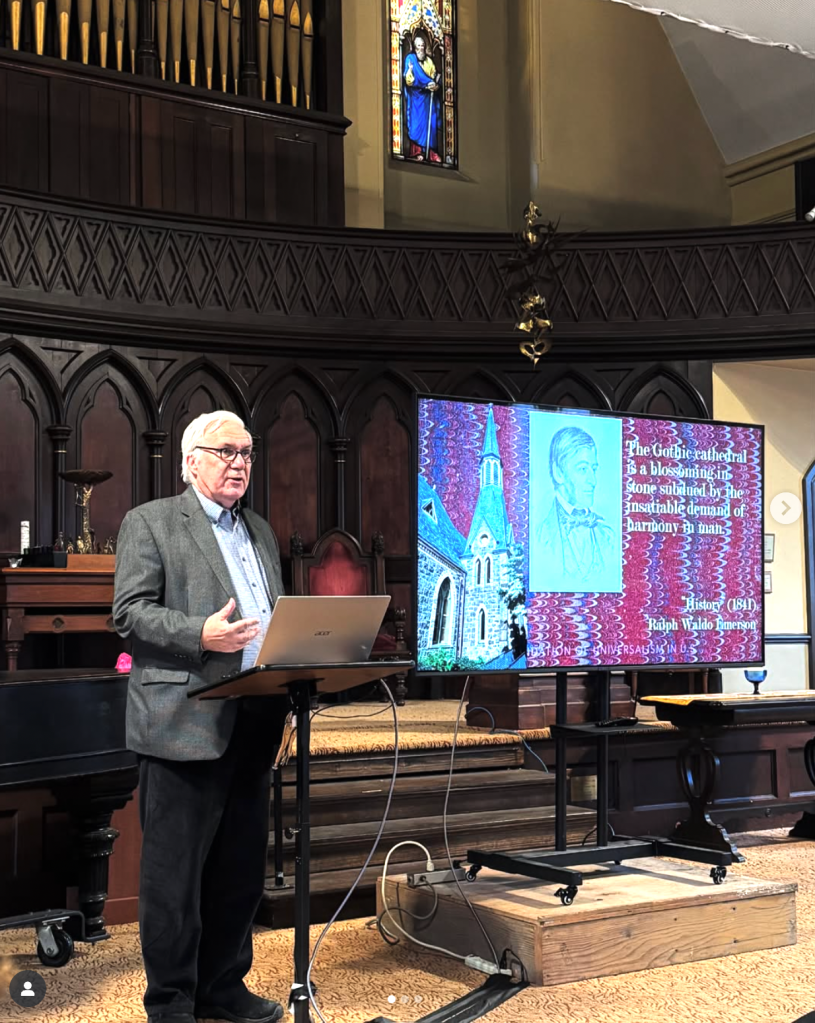
About Wes Haynes:
A Stamford native with a long career as a historic preservation specialist in the tri-state region, Wes Haynes researches historic places and works with their owners on how to adapt them to new uses or keep them in good repair. Within the past 10 years he has served as an interim director of the CT Trust for Historic Preservation (now Preservation CT) and executive director of the Merritt Parkway Conservancy where he remains on the board. He is also currently on the boards of the Highland Green Foundation, a non-profit affiliated with Stamford’s First Presbyterian Church in support of the architectural preservation of the Fish Church, the Pequot Library in Southport, and the Fairfield County Preservation Network. He also volunteers as a preservation advisor to the Mary and Eliza Freeman Center for History and Community in Bridgeport, the New Canaan Preservation Alliance, and the Sasco Creek Neighbors Environmental Trust in Fairfield, a grassroots organization advocating to bury a new powerline that United Illuminating proposes to convey overhead on poles up to 20 stories high through 8 historic districts.
 EHF
EHF 
Leave a comment